Most finance professionals write cover letters that recruiters skip in seconds. Yours does not have to be one of them. A strong finance cover letter proves you understand business impact, not just job duties. This guide covers the exact structure, language, and examples that finance recruiters respond to. You will learn how to open strong, show real achievements, and close with confidence — whether you are a Finance Manager, Controller, FP&A professional, or CFO candidate.
What Is a Finance Cover Letter and Why It Still Matters
A finance cover letter is not a summary of your resume. It explains why you are right for this specific role, in your own words.
Finance roles depend on trust. Hiring managers use your cover letter to judge two things fast: can you communicate clearly, and can you connect your experience to their actual problem.
This matters more in finance than in most fields. A Controller who cannot write a clear sentence raises doubts about how they write board reports. A Finance Manager whose letter is generic suggests they did not research the business.
Example: A Commercial Finance Manager applying to a retail chain mentioned a specific margin problem retailers face — shrinkage and markdown pressure — instead of writing generic praise for the company.
Takeaway: Treat the cover letter as proof of judgment, not a formality.
The 5-Part Structure of a Strong Finance Cover Letter
Every effective finance cover letter follows the same skeleton. Fill in the details, but keep this order.
- Header — your name, contact details, date, and the hiring manager's name if you have it
- Opening hook — the role you want and one strong, specific achievement
- Value proof — two or three quantified results that match the job description
- Fit paragraph — one line connecting your background to the company's situation
- Closing — a confident call to action and your availability
Why it matters: recruiters scan in under 20 seconds. A predictable structure lets them find what they need without hunting for it.
Actionable takeaway: Draft your letter section by section, not top to bottom in one pass. It stops you from padding the opening with filler.
How to Start a Finance Cover Letter
Your first two lines decide whether the rest gets read. Skip the greeting filler and lead with substance.
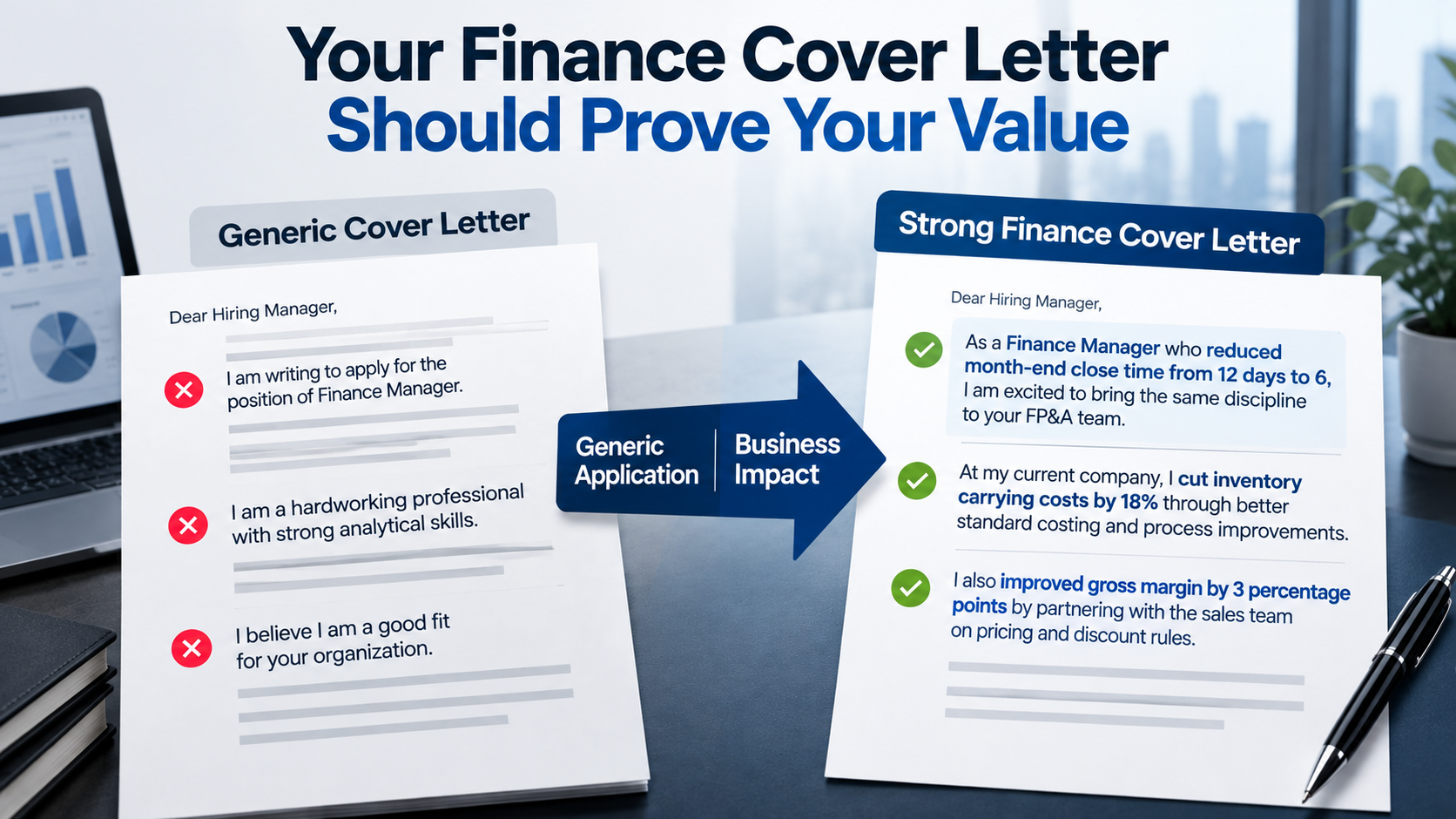
Do not open with "I am writing to apply for the position of..." Every recruiter has read that line a thousand times. Open with the role and a number instead.
Good vs Weak Opening Example
| Weak Opening | Strong Opening |
| "I am writing to express interest in the Finance Manager role at your esteemed organization." | "As a Finance Manager who cut month-end close time from 12 days to 6, I want to bring that same discipline to your FP&A team." |
| "I saw your job posting and believe I am a good fit." | "Your job posting for a Financial Controller matches the exact challenge I solved at my current company: rebuilding a compliance-ready reporting process from scratch." |
Why it matters: A specific opening signals confidence and relevance in one line. A generic opening signals a mass-sent application.
Realistic example (Manufacturing): "As a Finance Controller who reduced inventory carrying costs by 18% through better standard costing, I am applying for the Finance Controller role at [Company]."
How to Prove Your Value in the Body Paragraphs
The body is where most finance cover letters fail. Candidates list duties instead of results. Recruiters want proof, not a job description repeated in prose.
Use this simple pattern for each achievement: Situation → Action → Result (in numbers). Keep each one to two sentences.
Skills to highlight, by role:
| Role | Skills to Emphasize |
| FP&A Professional | Forecasting accuracy, variance analysis, business partnering |
| Finance Controller | Month-end close, internal controls, audit readiness |
| Finance Manager | Budgeting, cost control, cross-team collaboration |
| Tax Manager | Compliance accuracy, tax planning, regulatory updates |
| Treasury Manager | Cash flow forecasting, banking relationships, risk hedging |
| Internal Audit Manager | Risk assessment, process improvement, control testing |
| CFO / Finance Director | Strategic planning, fundraising, board reporting, P&L ownership |
Industry-specific examples:
- Banking: "Led regulatory reporting redesign that cut RBI submission errors by 40%."
- NBFC: "Improved loan-loss provisioning accuracy, reducing audit queries by half."
- Insurance: "Streamlined claims reserving process, saving 200 analyst hours per quarter."
- Retail: "Improved gross margin by 3 points through SKU-level cost analysis."
- FinTech / SaaS: "Built the unit-economics model the board used to justify Series B funding."
- Shared Services: "Automated three manual reconciliation processes, cutting close time by 30%."
- Startups: "Managed 18-month cash runway planning through two funding rounds."
Actionable takeaway: Pick your two strongest results and delete everything else. One clear number beats five vague claims.
How to Close a Finance Cover Letter
End with confidence, not a plea. State your interest, your availability, and a next step.
Avoid lines like "I hope to hear from you" or "I would be grateful for the opportunity." These sound passive and are overused.
Strong closing example: "I would welcome the chance to discuss how my experience in cost optimization can support [Company]'s next growth phase. I am available for a call this week."
Why it matters: A confident close matches the tone finance leadership expects — decisive and clear.
Finance Cover Letter Examples by Role
Each finance role should shift its emphasis. Here is what to lead with, by seniority and function.
| Role | What to Lead With |
| CFO | Strategic impact — fundraising, M&A, board relationships, company-wide P&L results |
| Finance Director | Cross-functional leadership and multi-entity financial oversight |
| Finance Controller | Control environment, audit outcomes, close-cycle efficiency |
| FP&A Manager | Forecasting accuracy and business partnering with non-finance teams |
| Finance Manager | Budget ownership and cost management for a specific unit or region |
| Tax Manager | Compliance track record and risk reduction in filings |
Realistic example (MNC, Finance Director level): "I led financial integration for two acquisitions across three countries, standardizing reporting under a single ERP within nine months."
ATS-Friendly vs ATS-Unfriendly Cover Letters
Many finance cover letters never reach a human. Applicant tracking systems (ATS) scan for relevant keywords and simple formatting first.
| ATS-Friendly | ATS-Unfriendly |
| Plain text or simple Word/PDF formatting | Text boxes, columns, or graphics |
| Keywords matched to the job description | Generic language with no role-specific terms |
| Standard fonts (Arial, Calibri, Times New Roman) | Decorative fonts or icons |
| File named clearly (e.g., FirstName_LastName_CoverLetter.pdf) | File named "Document1.pdf" |
| Saved as PDF unless the posting requests otherwise | Scanned images of text |
Why it matters: If the ATS cannot parse your formatting, a recruiter never sees your strongest lines — no matter how well written they are.
Common Mistakes Finance Professionals Make
- Repeating the resume — the cover letter should add context, not duplicate bullet points
- Using vague claims — "improved efficiency" means nothing without a number
- Writing one generic letter for every job — recruiters can tell within a sentence
- Overusing jargon — terms like "synergy" or "value-add" weaken your writing instead of strengthening it
- Making it too long — anything past one page loses the reader
- Ignoring the job description — not matching language to what the employer actually asked for
- Weak subject lines in email applications — "Application" tells the recruiter nothing
Fix: For each mistake, rewrite the sentence with one specific detail: a number, a tool, a team size, or a timeframe.
Best Practices Recruiters Appreciate
- Address the letter to a named person whenever possible
- Match at least three keywords from the job posting naturally
- Keep the letter to three or four paragraphs, under 300 words
- Lead every paragraph with the strongest point, not the buildup
- Proofread for numbers — a wrong figure damages credibility instantly in finance
- Save and send as a PDF unless told otherwise
- Use the same tone as your resume and LinkedIn profile for consistency
Expert Tips From a Recruitment Perspective
Recruiters read hundreds of finance applications per role. A few patterns consistently stand out.
Tip 1: Mention a business outcome, not just a task. "Reduced DSO by 12 days" is more persuasive than "Managed accounts receivable."
Tip 2: For senior roles (Director and above), reference scale — team size, budget size, or number of entities managed.
Tip 3: If you are changing industries (e.g., banking to FinTech), use the opening paragraph to explain the transferable skill directly. Do not leave the recruiter to guess.
Tip 4: Skip salary expectations in the cover letter unless the job posting specifically asks for them.
Key Takeaways
- A finance cover letter should explain why you, not repeat your resume
- Follow the five-part structure: header, hook, proof, fit, close
- Open with a specific, quantified achievement instead of a generic greeting
- Use the Situation → Action → Result pattern for every claim
- Match language from the job description to pass ATS screening
- Keep the letter under 300 words and one page
- Tailor the emphasis based on the role — strategic for CFOs, technical for Controllers
- Proofread numbers carefully; accuracy is part of your pitch in finance
A finance cover letter works when it proves judgment, not when it repeats your resume. Follow the five-part structure, lead with numbers, and match the language of the job description.
Next action: Take your current cover letter and rewrite only the opening line using one specific, quantified achievement. That single change improves your odds of being read in full.